
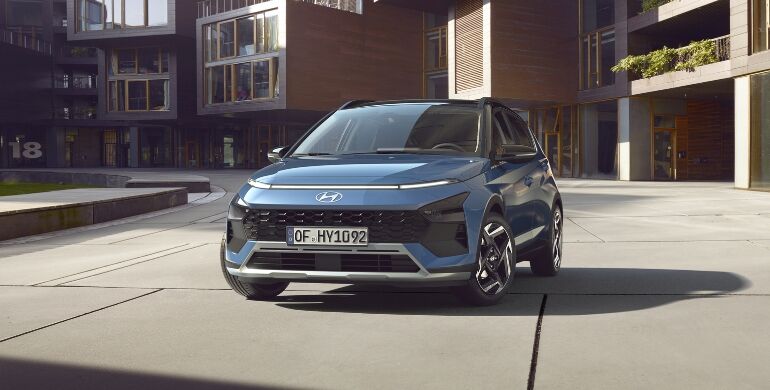
Need an i20 that looks a little more “rugged”? Then the new Bayon is the car for you.
Meet the new Hyundai Bayon. For those of you not familiar with the outgoing model, Bayon is essentially Hyundai’s attempt to cash in on the booming compact crossover market. As such, the running gear is transplanted directly from Hyundai’s excellent little i20 hatchback into a similar car with a loftier ride-height and chunkier styling, creating the illusion of some off-road ability.
Illusion really is the operative word, though: those attempting any serious off-roading will quickly be humbled thanks to a lack of four-wheel-drive and relatively modest ground clearance. Although the same criticism could fairly be levelled at rivals like Ford’s Puma and Peugeot’s 2008, which also boast little genuine off-road ability.
Interior and Technology
What has Hyundai done to improve this latest Bayon? Well, it’s all in the technology and interior refinements. On the former front, buyers now benefit from a 10.25-inch LCD instrument cluster, with a separate 10.25-inch Audio Visual Navigation Screen (AVN) screen as standard – Apple CarPlay/Android Auto and wireless phone charging also feature. And you’ll be able to listen to your favourite playlists in crystal clarity thanks to an eight-speaker Bose Audio System.
Image credit: Hyundai
Semi-autonomy has also come to the Bayon for the first time, which is something that few rivals can match. For example, Lane Following Assist (LFA) works to keep the vehicle centered in its lane, while Forward Collision-Avoidance Assist (FCA) can sound an alarm, then, if necessary, apply the brakes to avoid an accident.
Performance and MPG
Every Hyundai Bayon is powered by a 100 hp three-cylinder petrol engine, available with a six-speed manual or seven-speed dual-clutch automatic. So it's no rocket, but the 0-60 mph time of between 11.3 and 13.3 seconds, should be ample for most crossover customers.
Another obvious plus of the new Bayon’s ICE powertrain is that it won’t be troubled by the range anxiety of more expensive electric-only options. In fact, both the manual and automatic versions of the Bayon are impressively economical, returning around 50–51mpg on a combined cycle. CO2 emissions are low too, at roughly 125g/km, which means first-year road tax comes in at just £220.
Hyundai Bayon 2026 Price
As of 2026, the Bayon starts from £23,795 in the UK for the entry-level Black Line model. While those looking for upgrades like the Bose speakers and sliding sunroof will need to spend £25,295 for the top-spec Tech Line edition.Conclusion
As long as the SUV fashion trend booms, cars like this will continue to sell like hotcakes. But does the Bayon make more sense than its i20 supermini sibling? And, is the the Hyundai Bayon a better car than the Ford Puma and VW T-Cross? Let us know what you think.
Hero image credit: Hyundai