
Tony the Tiger, Ronald McDonald and Mickey Mouse – just a few of the many iconic mascots throughout the history of branding that have helped shape their respective brands’ global recognition.
Among these famous figures, one of the most recognisable mascots of all time is Bibendum – better known around the world today as the Michelin Man.
Michelin are a global powerhouse, renowned for both their innovative
tyre manufacturing and their prestigious
Michelin Stars in the culinary world. But behind this success lies a standout element of their branding: the beloved Michelin Man.
So, where did the background to this industry icon come from? And how did he become one of the most enduring brand mascots in history? Let’s take a deep dive into the origins, evolution and lasting impact of Bibendum.
Humble Beginnings
The origins of the Michelin Man date back to 1894 at the Lyon Universal and Colonial Exhibition.
Held in Lyon, France, the exhibition attracted around 3.4 million visitors. Among them were two key individuals: Michelin’s founder, Édouard Michelin, and his brother André.
The legend has it that Édouard noticed a pile of
tyres stacked on top of each other at the world’s fair. He then turned to André and remarked, ‘With arms, it [the pile of tyres] would make a man.’ This would go on to be the inspiration for one of the most iconic brand mascots of all time.
Fast-forward four years later to 1898, professional cartoonist Marius Rossillon collaborated with Michelin to create Bibendum.
Bibendum would first feature on an advertising poster for Michelin with the title ‘Nunc est bibendum’, which is Latin for ‘now is the time to drink’.
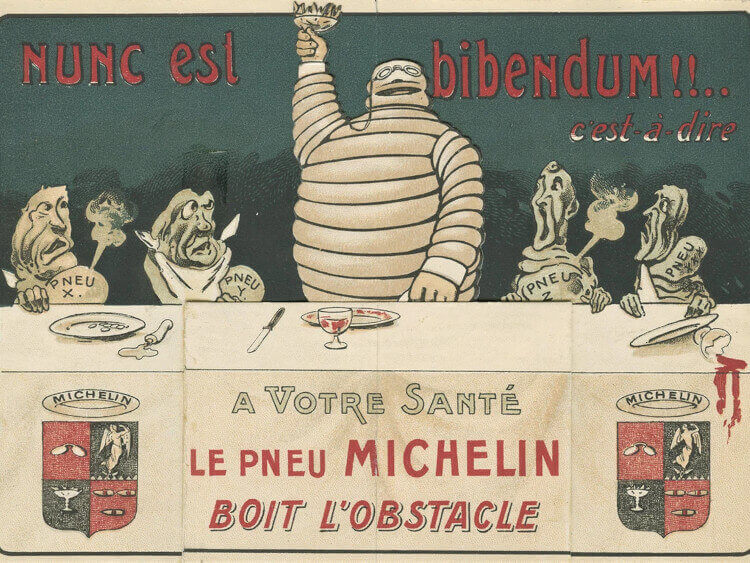
While rocking a different look from modern redesigns, the Michelin Man had the same tyre-inspired body design and the famous white tone.
The reason why the Michelin Man has always been white is that tyres were naturally manufactured in that colour back in the late 19th century.
Since the first appearance of Bibendum in 1898, the mascot has been a cornerstone of Michelin branding and advertising, being a prominent feature of Michelin’s identity ever since.