

When
Pirelli invited us to put the
Scorpion Zero All Season through its paces at Goodwood's challenging chalk pit, the question on everyone's lips was the same: can a road-biased all-season tyre really cut it when the going gets tough?
Fortunately, we had the perfect setting to find out. The chalk pit — a disused quarry carved into the Sussex Downs on the Goodwood Estate — is about as unforgiving an off-road environment as you're likely to find in the UK. Loose, powdery chalk surface. Steep inclines. Sheer drops. Hidden tree stumps and sidewall-smashing stones. It's the kind of terrain that separates serious off-road rubber from everything else. Or so we assumed.
Here's what our morning’s testing taught us.
The Test Car: Land Rover Defender 110 D300
Before we get to the tyre, it's worth talking about the machine we tested it on — because the two are, in many ways, perfectly matched.
Land Rover’s latest Defender 110 needs little introduction. It's a car that has always stood for one thing above all else: the ability to go anywhere, whatever the conditions. But in its latest generation, it does so with a level of composure and on-road refinement that would have seemed impossible to its rugged, agriculture predecessors.
Behind the wheel in the quarry, the Defender's intelligent Terrain Response 2 system quietly and continuously adapted to whatever surface and gradient we threw at it without even breaking a sweat. Crawl Control managed speed on the steeper descents, while the electronic air suspension kept the body level and the tyres firmly in contact with the terrain. The technology works so seamlessly that daunting off-roading feats feel almost unremarkable — even for novice trail drivers. 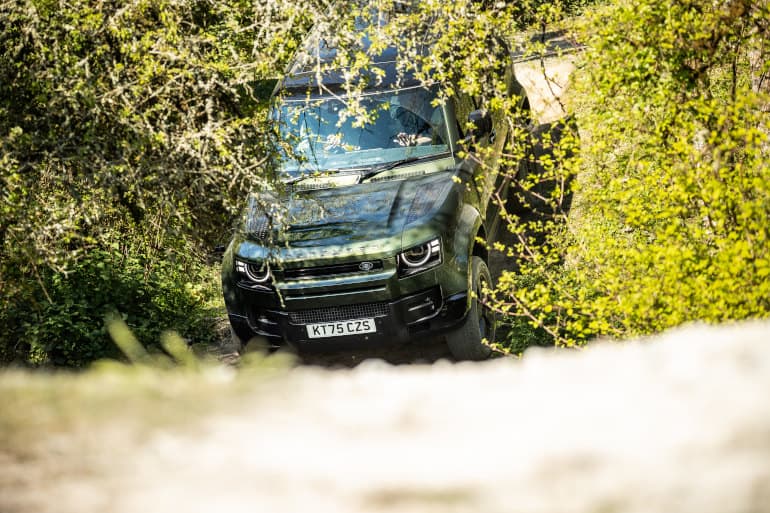
What struck us most was the duality at the heart of the Defender: the same car that glides quietly along the motorway, compliant and settled, becomes a composed, capable machine the moment the road disappears. And as we'd discover, that sense of duality is something it shares with the tyre it was wearing.