
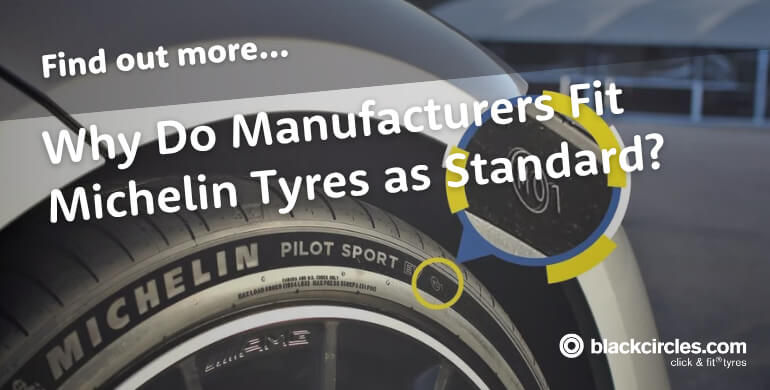
Car manufacturers fit Michelin tyres as standard when Michelin has developed a tyre specifically for the vehicle and the manufacturer has approved it through a process called homologation.
The approved tyre may be tuned for the car’s braking, steering, ride comfort, efficiency, noise levels, weight and power delivery. It normally carries a manufacturer-specific marking on its sidewall, such as MO for Mercedes-Benz, a star for BMW or T0 for Tesla.
In many cases, drivers can legally fit a suitable non-OE tyre that meets the vehicle’s required size, load index and speed rating.
However, an approved OE version may preserve the handling, refinement, efficiency or acoustic performance developed for the vehicle.
Drivers should check the vehicle handbook, manufacturer guidance, insurer requirements and the advice of a qualified tyre fitter before changing specification.
What does "fitted as standard" mean?
The term that you may see banded around when it comes to OE fitments by drivers is "standard fit." The term that the motoring industry uses is homologation.
Homologation means a tyre model has been formally developed for a particular vehicle and approved by that vehicle's manufacturer.
Each manufacturer sets its own criteria. These criteria exist to deliver a solution to specific engineering problems that a vehicle may present. A city runabout, a 2.5-tonne electric SUV and a rear-drive performance saloon all pose completely different questions - in terms of what is needed from a tyre to get the best out of them.
The process of developing an OE tyre is slower than you might think. From initial design, through testing, through adjustment, to final sign-off, homologation can take up to three years.
The tyre manufacturer begins with a prototype and repeatedly adjusts its compound, construction and tread design until it meets the vehicle manufacturer’s targets.
That's why the tyre on a new car is rarely a generic, off-the-shelf product. It's frequently a version of a familiar tyre line with a different compound, a different internal construction, sometimes different noise-reduction technology.